



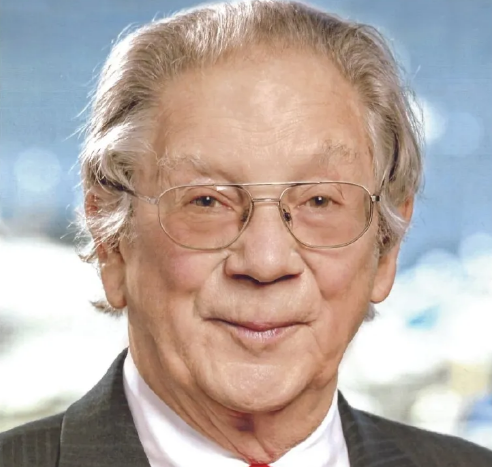
The late Peter Meyer III constantly amazed his family with his generosity and concern for others. In fact, he spent much of his life contributing to more than 50 charities around the world. When he learned that Jupiter Medical Center needed help to build its Anderson Family Cancer Institute, he was eager to help. As a former managing director at the specialist brokerage firm Henderson Brothers and a member and seat holder on the New York Stock Exchange, Peter was in a position to do so.
“My father was charitable because he believed in helping where and when he could,” says his son Bruce Meyer, who also retired from Henderson Brothers and now lives in Jupiter. “He was so humble, he never sought attention.”
Peter, who passed away on March 24, 2019, is also survived by his wife, Irma; another son, Richard; daughter, Barbara Keating; sister, Dorothy Purcell; and six grandchildren. He was a lifelong contributor to health-related, cultural, and educational charities, as well as food banks and homeless shelters.
Some of his favorite charities included the Visiting Nurses Association of New Jersey; the American Cancer Society; Magen David Adom, a national ambulance service in Israel; the Holocaust Memorial Museum in Washington, D.C.; and Girl Scouts of the USA. “He gave to large organizations as well as to smaller individuals who needed help,” says Bruce.
“Whether it was $300 or $3 million, giving back made him feel good.” Dividing his time between Admirals Cove in Jupiter and a summer home in Little Silver, New Jersey, Peter was asked by Jupiter Medical Center to help fund the construction of the Anderson Family Cancer Institute (opening in February 2020). Immediately, he thought it was a wonderful project to be involved in. “Dad really liked the person who approached him, and since he lived so close to the hospital, he was even more eager to help this cause,” recalls Bruce. “He felt it was a way he could reach many people.”
The Anderson Family Cancer Institute will offer fellowship-trained physicians who diagnose, evaluate, and develop personalized treatment plans for patients with known or suspected breast, gynecologic, thoracic, hepatobiliary, head and neck, genitourinary, and skin cancers. The Institute’s cancer specialists will work collaboratively within the community and with top academic cancer institutions throughout the United States to evaluate each patient’s diagnosis and develop personalized treatment.
Cutting-edge technology will be an integral part of patient care at the Institute, including: CyberKnife ®, a nonsurgical, pain-free treatment for patients who have inoperable or surgically difficult cancerous and noncancerous tumors; Electron Beam IntraOperative Radiation Therapy (e-IORT), which delivers a much smaller, more targeted form of radiation; and the TrueBeam® radiotherapy system, the most advanced medical linear accelerator, which customizes high-energy X-rays or electrons to conform to a tumor’s shape, then destroys the cancer cells while sparing normal surrounding tissue.
Peter was raised by a family who put philanthropy front and center in their lives. His parents regularly gave back, so one could argue selflessness and helping others was in his DNA. In 1956, after graduating from Rutgers University with a degree in English, Peter married Irma. He served as a First Lieutenant in the U.S. Army Signal Corps for two years and was a member of the Reserves until 1962. While working and raising his family, he became a lifelong supporter of his alma mater, was a member of the advisory board of Interfaith Neighbors, on the board of trustees at CPC Behavior Healthcare Real Estate Board, and on the board of governors of the Riverview Medical Center. He was also chairman of the board of the publicly traded Texas Pacific Land Trust.
A voracious reader, Peter devoured three or four books a week and constantly worked crossword puzzles. He was also active in sports, participating in marathons, playing golf, swimming, and fishing— another childhood passion inherited from his parents. “My grandparents were world-recognized for deep sea fishing and spent winters in Stuart,” says Bruce. “Dad grew up doing the same.”
In 1990, Peter and Irma moved to Jupiter part-time and became snowbirds. Peter loved his custom sportfishing boat, and the couple spent lots of time with old and new friends from New Jersey and other places who also owned homes in Florida. “My parents loved going to the Kravis Center, the Maltz Jupiter Theatre, dining out, and learning about the wine culture in the United States and abroad,” says Bruce, adding that they traveled extensively throughout Europe, Australia, and Israel. They also toured the States, including Alaska, Hawaii, Texas, and Louisiana—where they enjoyed the jazz, food, and people of New Orleans.
Those who knew him would agree that Peter was a well-respected man who loved his wife and supported his children in their endeavors, encouraging them to be productive and to follow their bliss. When his daughter, Barbara, decided to leave Wall Street to become a teacher, Peter paid for her additional education without questioning her choice. “Dad was accepting, not too strict, and rarely gave his opinions,” says Bruce. “He was cheerful, smiling, and welcoming, and he never said bad things about people behind their backs. He saw the good in everyone and wanted all of us to be happy with whatever we pursued in our lives.”