



Sometimes, it’s the unexpected path that fills a life with purpose and provides new opportunities to use one’s unique talents in meaningful ways.
That’s exactly what happened to Ross Levine. He had been studying in Tel Aviv, Israel, having earned a master’s degree in Middle Eastern history and working on another in Arabic, when family circumstances presented an intriguing choice: continue his studies or pivot to lead the Chleck Family Foundation, a philanthropy started by his grandparents, David and Gladys Chleck.
The Boston native chose the latter. Through his work alongside his mother, Mara Levine, aunt Risa Chleck, and other relatives, he now oversees the grant-making entity as its president and executive director at the foundation’s Massachusetts headquarters.
“Having been a graduate student and working at a research center, I felt comfortable speaking to faculty and professors in different fields and learning how the funding structures for their projects work,” Levine says. “It’s exciting in that we can take the foundation in different directions. I can read about something and use the critical thinking and research components of my background to analyze new grants and projects.”
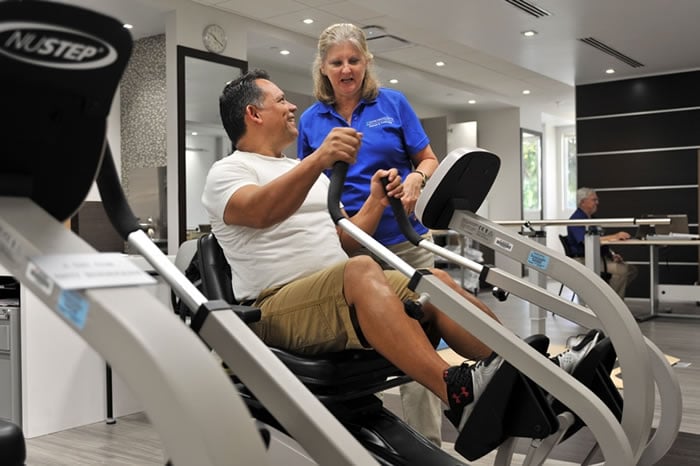
Among the Chleck Family Foundation’s gifts to medical and educational causes since its founding in 2014 have been grants totaling $600,000 toward continuing education and training for Jupiter Medical Center’s physical therapy, rehabilitation, and nursing personnel. The foundation also gave a one-time gift in March 2020 to support the hospital’s COVID Relief Fund, providing for enhanced personal protection equipment and other critical needs.
The Chleck family’s ties to the hospital go back many years. David and Gladys Chleck split their time between Boston and Jupiter for nearly four decades, spending the last 10 years of their lives enjoying the warm Florida climate full-time.
“They were very much a unit, very close,” Levine says of his grandparents. “They passed in 2017 within three months of each other after being married for more than 60 years. They were of their generation, more formal and conservative, dressing for cocktail hour and dinner and that sort of thing. My grandmother was social and glamorous. Grandfather was work-centric and serious. But he had sales offices in Asia and Europe, and they loved to travel and share stories of their adventures.”
As health issues arose late in life, the couple received superlative care from the team at Jupiter Medical Center, Levine notes. “My grandmother spent a significant amount of time there, in the advanced nursing wing and also for physical therapy,” he adds. “The quality of care and the commitment of the therapists and nursing team really helped extend her life. They both lived to be 90 and they received excellent care.”
Levine’s grandfather achieved his business success as the co-founder of Panametrics, a company that produced process control instrumentation, such as flow and humidity meters, for commercial and industrial applications that was later acquired by General Electric. This achievement had its roots in David Chleck’s early life growing up in New York City.
“The challenge for the foundation is narrowing the focus and mission,” Levine explains.
“We looked at my grandfather’s life experiences and used those as the guiding principles. He was born in the Bronx, the child of Eastern European immigrants, and studied for free at City College of New York in the 1940s. For those who could pass the entrance exams, it was an engine for upward mobility.”
Chleck’s higher education changed the course of his life, so Levine and Chleck’s other surviving relatives strive to preserve that legacy through the foundation’s gifts toward education. The philanthropy offers scholarships to undergraduates as well as graduate fellowships at Boston-area universities.
“Another important principle of my grandfather’s was research and development,” Levine says. “We’ve interpreted that with gifts toward R&D in the medical and health care fields. We have a cancer research fellowship and other medical research projects at Boston area hospitals, along with the educational support for Jupiter Medical Center.
“Ultimately, these projects become an investment in human capital and helping people gain additional education and training that they’ll bring back to the community. We felt there was this great infrastructure at Jupiter Medical Center, and this investment strengthens that.”
Levine and his wife, Dana, an architect, often travel to Jupiter with their 3-year-old son to visit extended family, and Levine reflects on how his grandparents’ medical needs as they aged expanded his empathy and support for quality senior health care. “Jupiter has changed and has more families and young people, but seniors still represent a large segment of the population of the community,” he notes. “We really wanted to give back and strengthen nursing and therapy so seniors can age gracefully and extend their lives.”