CARDIAC AND SLEEP TECH
By Denise Scott
Wearable health-monitoring devices have come a long way from manual, waistband pedometers. Today’s modern offerings, such as smartwatches and smart rings, can monitor everything from your heart rate and blood pressure to sleep patterns.
Read More
THE PROTEIN PUZZLE
By Eric Barton
Some days, Lindsey Modica puts an afternoon snack out for her kids, and it disappears before she’s barely turned around. “Where did that piece of chicken and that cheese stick go?” she’ll ask. “Oh, I ate it,” they’ll reply. Then she knows: growth spurt. That sudden pull toward protein is the body knowing what we need to build and maintain muscle. It’s the same biology that helps adults maintain muscle, recover from stress, and feel steady between meals.
Read More
SUPPLEMENTS GALORE
By Kelley Marcellus
These days, the promise of improved health seems as simple as coming up with the right cocktail of the vitamins and supplements that appear on grocery store shelves and across social media platforms. Everyone from lifestyle influencers to health and fitness gurus are encouraging supplementing, which can leave consumers confused about what to expect, what works, and what might cause more harm than good.
Read More
STAYING BALANCED
By Phil Borchmann
Dizzy spells are the primary reason people over the age of 45 visit their doctor. In addition to discomfort and disruption in daily living, the symptoms may indicate underlying health issues. Pinpointing the source, however, will require some digging.
Read More
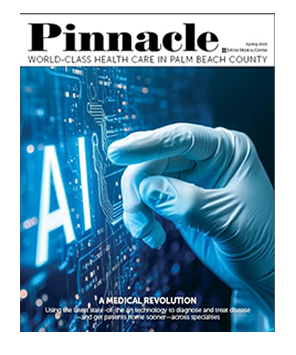
A MEDICAL REVOLUTION
By Eric Barton
The first thing you notice about the new tech being employed at Jupiter Medical Center isn’t whirring machinery or glowing screens. It’s the pace. Patients who once braced for a weeklong hospital stay now spend a couple of nights—or a few hours. Operations that once demanded large incisions are tackled through tiny ports. Treatments that used to require multiple surgeries can be done as outpatient procedures.
Read More
CARE CONTINUUM
By Karen Feldman
All ships are boats, but not all boats are ships—and so it is with palliative and hospice care.
Read More
TRANSFORMING TREATMENTS
By Michele Meyer
New tests and tools are enabling Jupiter Medical Center urologists and urologic oncologists to detect and remove genitourinary—genital and urinary—cancers faster, with more precision and better outcomes.
Read More
BALANCING RISK & REWARD
By Erika Klein
When a patient came to Dr. Donna M. Pinelli for treatment of ovarian cancer, Pinelli ordered genetic testing that revealed a high hereditary risk affecting not only the patient but potentially her family members as well. As a result, other family members received testing, revealing several relatives at very high risk for breast and ovarian cancer, which led to the patient’s daughter to opt for risk-reduction surgery to remove her uterus, ovaries, and fallopian tubes to lower her own high risk of cancer.
Read More
A LIFESAVING SCAN
By Cathy Chestnut
Mary Jordan is thankful for diagnostic screening—she owes her life to it.
Read More